Address
304 North Cardinal
St. Dorchester Center, MA 02124
Work Hours
Monday to Friday: 7AM - 7PM
Weekend: 10AM - 5PM
Address
304 North Cardinal
St. Dorchester Center, MA 02124
Work Hours
Monday to Friday: 7AM - 7PM
Weekend: 10AM - 5PM


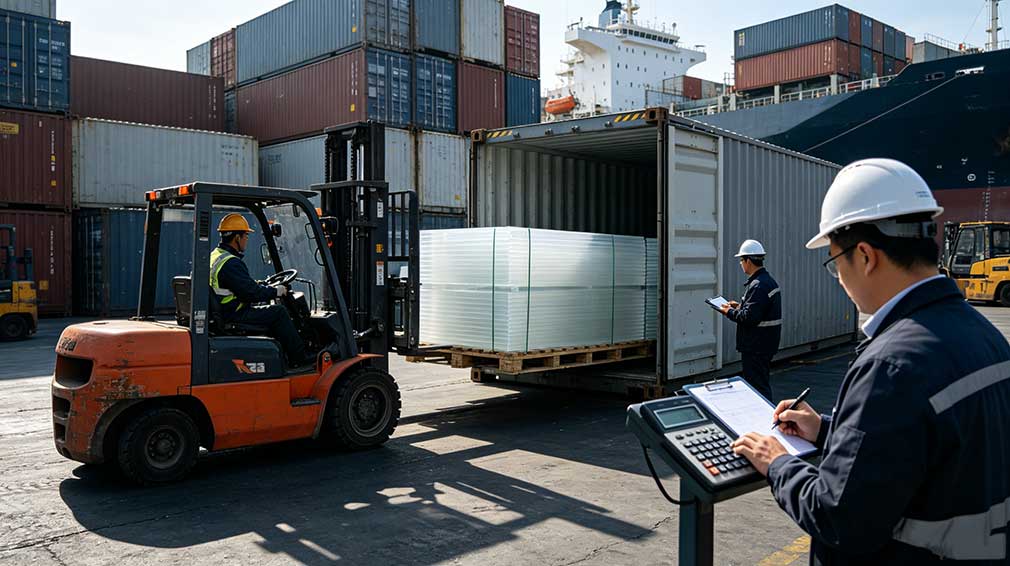
For businesses importing acrylic sheets into Malaysia, accurately calculating the total weight before sea shipment is a critical step in the logistics process. The weight of the cargo directly impacts shipping costs, container space planning, and compliance with maritime safety regulations. This article provides a comprehensive guide on how to calculate acrylic sheet weight before sea shipment to Malaysia, ensuring that importers can plan their shipments efficiently and avoid unexpected costs or delays.
Before delving into the calculation process, it’s important to understand why accurate weight calculation is so crucial for sea shipments of acrylic sheets to Malaysia:
The weight of an acrylic sheet is determined by several key factors:
The most obvious factor affecting the weight of an acrylic sheet is its size. Larger sheets have a greater surface area and therefore weigh more than smaller sheets of the same thickness and material type.
The thickness of the acrylic sheet is another critical factor. Thicker sheets have more material volume and are significantly heavier than thinner sheets of the same dimensions and material type.
The type of acrylic material also affects the weight. Cast acrylic and extruded acrylic are the two most common types, and they have slightly different densities. Cast acrylic typically has a higher density (around 1.20 g/cm³) than extruded acrylic (around 1.18 g/cm³), which means that a cast acrylic sheet of the same dimensions and thickness as an extruded acrylic sheet will weigh slightly more.
The density of the acrylic material is a fundamental physical property that relates its mass to its volume. To calculate the weight of an acrylic sheet, you need to know its density. As mentioned above, the density of acrylic typically ranges from 1.18 g/cm³ to 1.20 g/cm³, depending on the type and manufacturer.
Calculating the weight of an acrylic sheet is a straightforward process that involves a few simple steps:
The first step is to measure the length, width, and thickness of the acrylic sheet. It’s important to use consistent units of measurement throughout the calculation. The most common units used for acrylic sheet dimensions are millimeters (mm) or meters (m).
Once you have the dimensions, you can calculate the volume of the acrylic sheet. The volume (V) of a rectangular sheet is calculated by multiplying its length (L), width (W), and thickness (T):
V = L × W × T
For example, if you have an acrylic sheet with dimensions of 1220 mm (length) × 2440 mm (width) × 5 mm (thickness), the volume would be:
V = 1220 mm × 2440 mm × 5 mm = 14,976,000 mm³
To calculate the weight in metric tons (t), which is the unit commonly used for sea shipments, you need to convert the volume from cubic millimeters (mm³) to cubic meters (m³). There are 1,000,000,000 cubic millimeters in a cubic meter, so you can convert the volume by dividing by 1,000,000,000:
V (m³) = V (mm³) / 1,000,000,000
Using the example above:
V (m³) = 14,976,000 mm³ / 1,000,000,000 = 0.014976 m³
Next, you need to know the density of the acrylic material used to make the sheet. As mentioned earlier, the density of acrylic typically ranges from 1.18 g/cm³ to 1.20 g/cm³. For most practical purposes, a density of 1.19 g/cm³ can be used as a general approximation. However, it’s always best to check with the acrylic manufacturer or supplier for the exact density of the specific acrylic sheet you are importing.
Once you have the volume in cubic meters (m³) and the density in grams per cubic centimeter (g/cm³), you can calculate the weight of the acrylic sheet in metric tons (t). It’s important to note that 1 metric ton (t) is equal to 1,000,000 grams (g) and 1 cubic meter (m³) is equal to 1,000,000 cubic centimeters (cm³). Therefore, the density in g/cm³ is numerically equivalent to the density in t/m³.
The weight (W) of the acrylic sheet can be calculated using the following formula:
W (t) = V (m³) × Density (t/m³)
Using the example above and a density of 1.19 t/m³:
W (t) = 0.014976 m³ × 1.19 t/m³ ≈ 0.0178 t
So, the weight of the acrylic sheet is approximately 0.0178 metric tons, or 17.8 kilograms (kg).
To calculate the total weight of the shipment, you simply multiply the weight of one acrylic sheet by the total number of sheets in the shipment. For example, if you are shipping 100 sheets of the same dimensions and thickness as in the example above, the total weight would be:
Total Weight (t) = Weight per Sheet (t) × Number of Sheets
Total Weight (t) = 0.0178 t/sheet × 100 sheets = 1.78 t
When calculating the weight of acrylic sheets for sea shipment to Malaysia, there are a few additional considerations to keep in mind:
The weight of the packaging materials, such as pallets, crates, and wrapping, should also be included in the total weight calculation. This is known as the “gross weight” of the shipment. The packaging weight can vary depending on the type of packaging used, but it’s typically around 5-10% of the net weight of the cargo.
Each shipping container has a maximum weight limit, which is determined by the container’s size and the shipping line’s regulations. For example, a standard 20-foot container typically has a maximum weight limit of around 28 metric tons, while a 40-foot container has a maximum weight limit of around 30 metric tons. It’s important to ensure that the total weight of the cargo and packaging does not exceed the container’s weight limit.
As mentioned earlier, all sea shipments must comply with the IMO’s VGM requirements. This means that the shipper must provide an accurate gross weight for the container and its contents before shipment. The VGM can be obtained by either weighing the packed container on a calibrated scale or by calculating the weight based on the net weight of the cargo, the weight of the packaging, and the weight of the container itself.
For businesses that are new to importing acrylic sheets into Malaysia or that are unsure about the weight calculation process, it’s highly recommended to work with a reputable freight forwarder. A freight forwarder can provide expert advice and assistance with all aspects of the shipping process, including weight calculation, container loading planning, and compliance with maritime safety regulations.
Calculating the weight of acrylic sheets before sea shipment to Malaysia is a critical step in the logistics process that requires accuracy and attention to detail. By following the step-by-step guide outlined in this article and considering the additional factors such as packaging weight, container weight limits, and VGM requirements, importers can ensure that their shipments are planned efficiently and comply with all relevant regulations.
Working with a reliable acrylic manufacturer or supplier, such as a Chinese acrylic factory that can provide accurate product specifications, and partnering with a reputable freight forwarder can further simplify the process and ensure a smooth and successful shipment.
So, if you’re planning to import acrylic sheets into Malaysia and need to calculate the weight for sea shipment, remember to measure the dimensions, calculate the volume, determine the density, and then apply the formula to find the weight per sheet and the total weight for the shipment. With careful planning and accurate calculations, you can ensure that your acrylic sheets arrive in Malaysia safely and on time.
