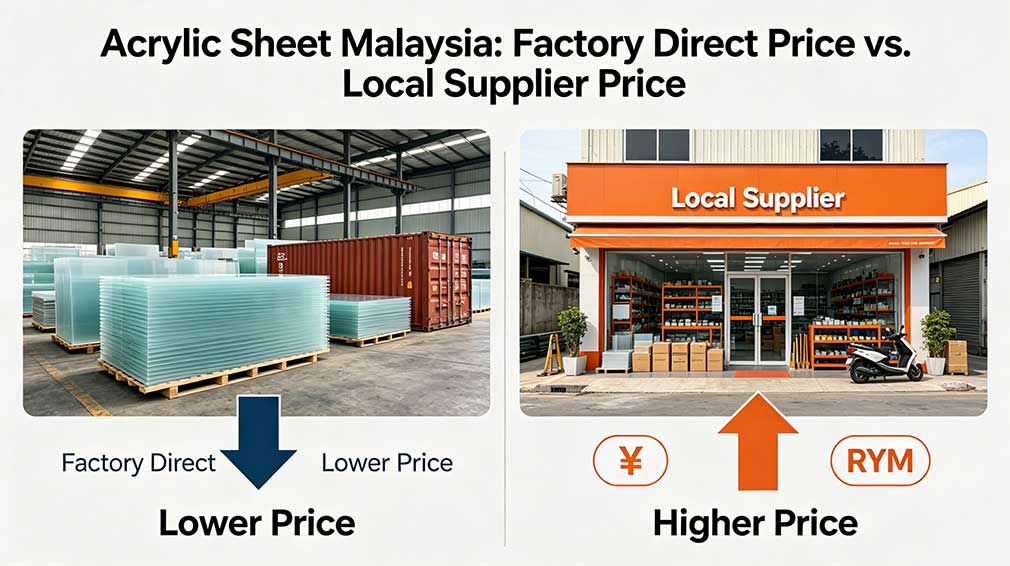
For businesses in Malaysia that rely on acrylic sheets, such as signage manufacturers, interior designers, and retail display builders, the cost of materials is a major factor in profitability. Two primary sourcing strategies exist: importing directly from overseas factories or purchasing from local Malaysian suppliers. Each approach has distinct implications for pricing, quality, and logistics.
This article provides a detailed comparison between factory direct prices (most commonly from China) and local supplier prices for acrylic sheets in Malaysia. By examining the true costs, benefits, and potential risks, businesses can make an informed decision that aligns with their operational needs and financial goals.
1. The Core Cost Breakdown: Factory Direct vs. Local Supplier
A. Factory Direct Price (e.g., from China)
When you import directly, the quoted price is typically the FOB (Free On Board) price. This is the cost of the goods themselves, loaded onto a ship at the supplier’s port. However, this is far from the final landed cost in Malaysia.
FOB Price: This is the base cost. For a standard 4ft x 8ft x 3mm clear cast acrylic sheet, the FOB price from a Chinese factory can be as low as RM 25 to RM 35 per sheet.
Additional Costs to Consider:
International Shipping: The cost of transporting a 20-foot or 40-foot container from China to Malaysia. A 20-foot container can hold approximately 1,000 sheets of 3mm acrylic. Shipping costs can range from RM 8,000 to RM 15,000 per container, adding roughly RM 8 to RM 15 per sheet.
Customs Duties and Taxes: As of 2024, under the ASEAN-China Free Trade Agreement (ACFTA), the import duty for acrylic sheets (HS Code 3920.51) is 0% if a valid Certificate of Origin (Form E) is provided. However, Goods and Services Tax (GST) of 6% is still applicable, calculated on the FOB value plus shipping and insurance.
Customs Brokerage and Documentation Fees: These fees cover the services of a customs broker to handle the clearance process at the Malaysian port. They can range from RM 500 to RM 2,000 per shipment.
Domestic Transportation: The cost to transport the goods from the port (e.g., Port Klang) to your warehouse in Malaysia. This depends on your location and the quantity ordered.
Quality Control and Inspection Fees: To mitigate risk, many buyers hire a third-party inspection company (like SGS or BV) to check the goods in China before shipment. This can cost US$ 300 to US$ 1,000 per inspection.
MOQ (Minimum Order Quantity): Factories usually require a minimum order, often a full container. This ties up significant capital and storage space.
Estimated Landed Cost per Sheet: Adding all these up, the estimated landed cost for a 3mm clear cast acrylic sheet imported directly from China can range from RM 45 to RM 65 per sheet.
B. Local Supplier Price
Purchasing from a local Malaysian supplier (e.g., in Balakong, Pudu, or Johor Bahru) is generally more straightforward. The quoted price is usually the ex-warehouse price, which includes the supplier’s costs and profit margin.
Ex-Warehouse Price: For the same 4ft x 8ft x 3mm clear cast acrylic sheet, a local supplier might charge RM 60 to RM 80 per sheet.
Additional Costs to Consider:
Local Delivery: The cost to deliver the goods from the supplier’s warehouse to your location. This is usually much lower than international shipping, perhaps RM 50 to RM 200 per order.
Handling Fees: Some suppliers may charge a small fee for loading or special handling.
Estimated Final Cost per Sheet: With local delivery, the final cost per sheet would be approximately RM 65 to RM 85 per sheet.
2. Comparing the Two Options: A Summary Table
表格
Factor
Factory Direct Import
Local Supplier
Base Price (per sheet)
RM 25 – RM 35 (FOB)
RM 60 – RM 80 (Ex-Warehouse)
Final Landed Cost
RM 45 – RM 65 per sheet
RM 65 – RM 85 per sheet
Price Advantage
Significant (20-30% lower cost per sheet)
None, but costs are predictable and transparent
MOQ Requirement
High (Full container, ~1,000 sheets)
Low (Can buy 1 sheet or a small bundle)
Lead Time
Long (20-45 days from order to delivery)
Short (1-7 days)
Logistics Complexity
Very High (Shipping, customs, documentation)
Very Low (Simple local delivery)
Quality Control Risk
Higher (Dependent on supplier and pre-shipment inspection)
Lower (Can inspect goods before purchase)
Stock Holding
Required (Need to store a large quantity)
Minimal (Can buy just-in-time)
Currency Risk
Yes (Fluctuations in RM/CNY or RM/USD)
No (Prices quoted in RM)
3. Which Option is Better for Your Business?
The decision between factory direct import and local supplier depends on several key factors:
Business Size and Order Volume:
Large Businesses: If you have the capital, storage space, and order volume to meet a factory’s MOQ, importing directly will almost certainly save you a significant amount of money in the long run.
Small Businesses or Startups: For smaller orders, the high MOQ and logistical complexity of direct import make local suppliers the only practical and cost-effective choice.
Cash Flow and Storage:
Direct import requires a large upfront payment and dedicated warehouse space to store the goods.
Local suppliers allow for smaller, more frequent purchases, improving cash flow and reducing storage costs.
Urgency of the Order:
If you need materials quickly to meet a project deadline, local suppliers are the clear choice due to their short lead times.
Direct import requires careful planning and forecasting to avoid stockouts.
Risk Tolerance:
Direct import carries more risks, including quality issues, shipping delays, and customs complications.
Local suppliers offer more control and flexibility, with the ability to inspect goods before purchase and resolve issues more quickly.
4. Tips for Making the Most of Both Options
For Direct Import:
Thoroughly Vet Suppliers: Check certifications, request samples, and consider a factory visit.
Hire a Reliable Freight Forwarder: A good freight forwarder can handle the complex logistics and help you navigate customs clearance.
Implement Strict Quality Control: Hire a third-party inspection company to inspect the goods in China before shipment.
Negotiate Favorable Terms: Negotiate the FOB price, payment terms, and delivery schedule.
For Local Suppliers:
Compare Prices: Get quotes from multiple suppliers to ensure you’re getting a fair price.
Build Relationships: Establishing a good relationship with a local supplier can lead to better prices, priority delivery, and more flexible terms.
Consider Value-Added Services: Some local suppliers offer cut-to-size services, which can save you time and money on material waste.
Conclusion
In the battle of Acrylic Sheet Malaysia: Factory Direct Price vs. Local Supplier Price, there is no one-size-fits-all answer. Factory direct import offers the lowest per-unit cost but requires a large upfront investment, significant logistical effort, and a tolerance for risk. Local suppliers, while more expensive per sheet, offer convenience, flexibility, and a lower barrier to entry, making them ideal for smaller businesses or urgent orders.
Many successful businesses in Malaysia adopt a hybrid approach: importing large quantities of standard acrylic sheets directly from factories to secure the best price, while using local suppliers for smaller orders, specialty items, or when they need materials quickly. By carefully evaluating your business needs, order volume, and risk tolerance, you can choose the sourcing strategy that best supports your profitability and growth.