Address
304 North Cardinal
St. Dorchester Center, MA 02124
Work Hours
Monday to Friday: 7AM - 7PM
Weekend: 10AM - 5PM
Address
304 North Cardinal
St. Dorchester Center, MA 02124
Work Hours
Monday to Friday: 7AM - 7PM
Weekend: 10AM - 5PM
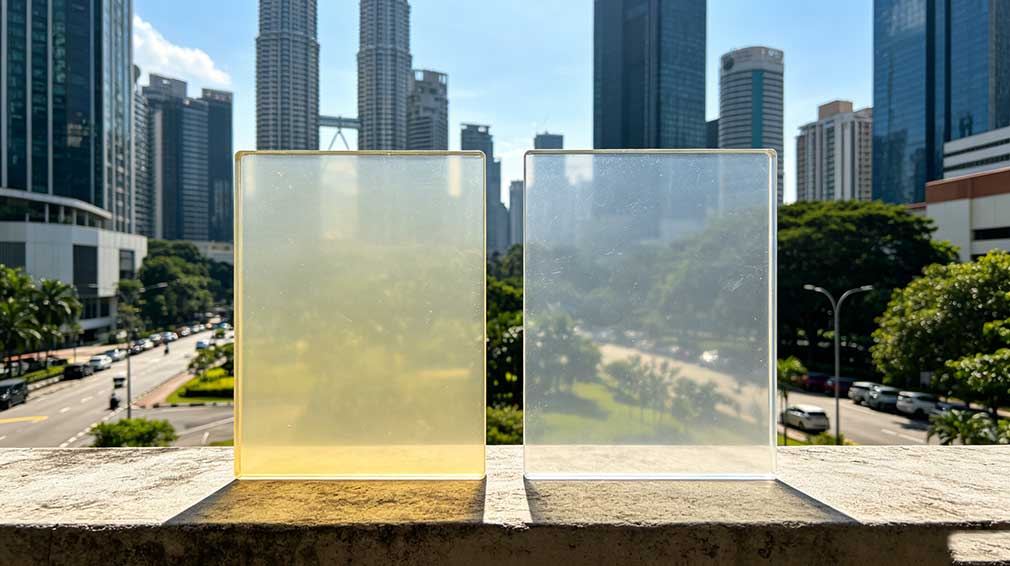
Kuala Lumpur (KL), Malaysia’s bustling capital, is renowned for its tropical climate, characterized by intense ultraviolet (UV) radiation, high temperatures, and persistent humidity. These harsh environmental conditions pose a significant challenge for materials used in outdoor applications, particularly clear acrylic sheets, which are valued for their transparency and aesthetic appeal. A common and critical question among architects, designers, and property managers is: Does clear acrylic sheet turn yellow after 3 years outdoor use in KL?
The answer is: It depends. A standard, low-quality clear acrylic sheet will almost certainly turn yellow, become brittle, and lose its transparency within 3 years of outdoor exposure in KL. However, a high-quality, UV stabilized acrylic panel anti-yellow, specifically engineered to withstand tropical conditions, can remain clear and durable for much longer, often exceeding 5-10 years without significant yellowing.
To understand why some clear acrylic sheets yellow while others do not, it is essential to delve into the science of polymer degradation. Clear acrylic sheets are made from polymethyl methacrylate (PMMA), a thermoplastic polymer composed of long molecular chains. When exposed to KL’s intense UV radiation and heat, these chains undergo a process called photo-oxidation.
Photo-oxidation breaks the long polymer chains into smaller fragments and creates new, chromophore-forming chemical bonds. These bonds absorb light in the blue spectrum, causing the acrylic to appear yellow. This process is accelerated by KL’s high temperatures, which increase molecular mobility, and humidity, which can introduce water molecules that further weaken the polymer structure. Over time, this degradation not only affects the sheet’s appearance but also its mechanical properties, leading to cracking and brittleness.
The ability of a clear acrylic sheet to resist yellowing in KL’s climate hinges on several critical factors:
The single most important factor is the presence of UV stabilizers in the acrylic formulation. High-quality sheets, like the UV stabilized acrylic panel anti-yellow, are infused with these chemical additives during manufacturing. There are two primary types:
Without these stabilizers, the degradation process in KL is rapid and unavoidable.
The manufacturing process also plays a significant role. Clear cast acrylic sheets are generally more resistant to yellowing than extruded acrylic sheets. Cast acrylic is produced by polymerizing liquid monomers in a mold, resulting in a material with a higher molecular weight, greater density, and a more uniform structure. This inherent quality makes it more durable and less prone to UV damage. Extruded acrylic, while cheaper and more flexible, has a lower molecular weight and a more porous structure, making it susceptible to faster yellowing.
The quality of the raw materials used to produce the clear acrylic sheet is another important factor. High-purity acrylic resin, free from contaminants and residual monomers, is less likely to undergo chemical reactions that lead to yellowing. Cheaper, lower-quality sheets often contain impurities that can act as catalysts for photo-oxidation, accelerating the yellowing process significantly.
Some advanced clear acrylic sheets come with a factory-applied protective coating. This coating acts as an additional barrier, shielding the acrylic surface not only from UV radiation but also from scratches, chemical stains, and water damage. While a good coating can enhance durability, it is not a replacement for high-quality, UV-stabilized acrylic core material.
Numerous real-world applications in KL demonstrate the stark difference between standard and UV-stabilized clear acrylic sheets:
These examples clearly illustrate that the choice of clear acrylic sheet material directly impacts its long-term performance in KL’s harsh outdoor environment.
To ensure your clear acrylic sheet remains clear and durable for as long as possible in KL, consider the following selection criteria:
Always choose a sheet explicitly labeled as “UV-stabilized” or “outdoor-grade.” The UV stabilized acrylic panel anti-yellow is an excellent example of a product designed for this purpose.
Whenever budget and application allow, specify clear cast acrylic sheet over extruded acrylic for superior yellowing resistance.
Source your acrylic sheets from a reputable manufacturer or supplier known for producing high-quality, consistent products. Look for brands that provide detailed technical data sheets and warranties for their outdoor-grade products.
Thicker sheets generally offer better durability and resistance to warping and cracking. For most outdoor applications in KL, a minimum thickness of 3mm to 5mm is recommended.
In conclusion, whether a clear acrylic sheet turns yellow after 3 years of outdoor use in KL is not an inevitable outcome but a direct result of the quality of the material chosen. A standard, non-UV-stabilized sheet will yellow and degrade rapidly. However, by selecting a high-quality, UV stabilized acrylic panel anti-yellow, preferably of the cast variety, you can significantly extend the sheet’s lifespan and maintain its optical clarity for many years, even in the face of KL’s intense tropical sun, heat, and humidity.
For any outdoor project in KL that requires clear, durable, and long-lasting materials, investing in a premium, UV-stabilized clear acrylic sheet is not just a choice but a necessity to ensure the project’s aesthetic and functional integrity over time.
